AI Coach Australia: What They Actually Do, What They Cost, and How to Choose One Who's Actually Ahead
A straight guide from someone who's been inside the AI revolution since it started — what an AI coach should really be teaching, what it costs in Australia in 2026, and why most business owners are 12 months behind where they need to be right now.
Key Takeaways
- •An AI coach helps a business owner move from using AI occasionally to building real leverage into their business — so AI compounds their time, output and competitive edge, rather than just helping them write emails faster.
- •In Australia in 2026, expect roughly $200–$500+ an hour, or $3,000–$6,000+ a month for ongoing guidance. The wide range reflects the fact that real AI expertise is genuinely scarce — and the gap between a certified generalist and someone who has actually deployed AI at scale in real businesses is enormous.
- •It's worth it when the window is open. Right now, being 12 months ahead of your competition on AI is the difference between owning the market and scrambling to catch up. That window won't stay open. The right coach compresses years of trial and error into months.
- •What an AI coach should be teaching you goes far beyond ChatGPT prompts. The real leverage is in voice leverage (talking to your computer, 3× faster output), vibe coding (building tools and websites by talking to AI — no developers needed), AI agents (automating entire workflows while you sleep), teaching AI your brand voice, and building a knowledge base so AI can act as you.
- •Choose on what they are actually running, not what they are teaching. The only AI coaches worth hiring are the ones whose own businesses are already being run on AI systems they've built. If they're not doing it themselves, they're teaching you theory.
- •The real advantage isn't knowing about AI. It's the speed at which you implement it — and the quality of the room you're in when you make those decisions.

What does an AI coach actually do?
Direct answer:An AI coach helps a business owner move from using AI occasionally and inconsistently to building real, compounding leverage into their business. A good AI coach doesn't just show you what tools exist — they help you identify where AI can multiply your output, implement the right systems, avoid the expensive wrong turns, and move fast enough to stay ahead of the market. The goal is leverage, not literacy.
That's the textbook version. Here's what it actually looks like in practice.
Most business owners have experimented with ChatGPT. Some are using it daily. Very few have built AI into the actual structure of how their business operates — so that AI is compounding their advantage while they're not working, not just helping them draft an email slightly faster.
There's a massive difference between those two things.
An AI coach who has genuinely built AI into real businesses at scale helps you see that gap, prioritise the highest-leverage moves, and implement them fast enough to matter. They're not teaching you about AI as a concept. They're showing you what they deployed last month — because the landscape changes that fast.
Most business owners think they're using AI. Very few have built AI into how the business actually runs. That gap is where the next generation of competitive advantage is being built right now.
What an AI coach is not: a prompt engineer who shows you clever ChatGPT tricks, a technology vendor selling you a platform, or a futurist who talks about AI without showing you what they've actually built. The coach compresses real-world implementation into your business. You still have to lead the change.
How much does an AI coach cost in Australia?
Direct answer: In Australia in 2026, AI coaching typically runs $200–$500+ per hour, with coaches who have real, verifiable AI implementation experience in real businesses charging $600+. Ongoing coaching commonly sits at $3,000–$6,000+ a month. The wide range exists because genuine AI expertise — the kind built by actually deploying AI systems in operating businesses — is still genuinely scarce. A coach who learned ChatGPT in a weekend costs very little. A coach who has replaced 30 employees with AI agents, built vibe-coded tools live with clients, and rebuilt their business around AI leverage is worth considerably more.
A few things drive the number:
/01 Real implementation track record.
Anyone can teach you to prompt ChatGPT. Very few people have actually deployed AI voice agents that replace a sales team, used vibe coding to cut their development costs by 90%, or built AI systems that run key parts of their business overnight. The ones who have charge accordingly — and are worth it.
/02 How current they are.
The AI landscape changes month by month, not year by year. A coach whose knowledge is six months old may be showing you tools that have already been superseded. The premium is for someone who is actively building and testing right now, every week.
/03 Format.
One-on-one implementation sessions are worth more than group training. An AI mastermind with serious peers who are all building at the same time sits in a category of its own — the collective intelligence of the room compounds.
/04 Scope.
Some coaches cover AI strategy. The best cover strategy and sit with you and build things — live, in your business, in a session.
AI leverage — the compounding business advantage that comes from having AI working systematically inside your operations, not just occasionally. The difference between using AI as a tool you pick up sometimes and building it into how your business runs every day.
The honest framing: cheap AI coaching is usually cheap because the coach learned from a YouTube video. The real question isn't what it costs. It's what 12 months of genuine AI advantage is worth to your business — and whether the person you're hiring has actually built it.
Is an AI coach worth it?
Direct answer:An AI coach is worth it when the window is still open — and right now, the window is open. Serious operators who implement AI systems in 2025–2026 will have an advantage that compounds for years. Those who wait until it's obvious will be catching up to competitors who moved early. A useful test: if building real AI leverage into your business could save 10–20 hours a week or add $100K+ to revenue, what would you pay for someone who has already done it and can compress a year of trial and error into a few months?
The thing nobody selling AI coaching wants to say plainly: being shown what's possible means nothing if you don't implement.
The same session that transforms one business does nothing for the next — and the difference is almost never the coach. It's whether the operator went back to their business and changed how things ran. AI coaching only compounds if you do the work of actually deploying it.
The window where being early to AI gives you a real competitive advantage is open right now. It won't stay open forever. The operators who move in the next 12 months will own the next decade. The ones who wait until it's obvious will spend that decade catching up.
So before you invest, get honest on two things: Do you have the conviction to actually change how your business runs, not just learn about AI? And is the person you're hiring someone who is living this themselves — whose own business runs on the systems they're teaching? If yes to both, good AI coaching is one of the highest-leverage investments available to a business owner right now. If no, you're buying confidence, not advantage.
AI coach vs AI course vs AI consultant: what's the difference?
Direct answer: An AI coach works with you over time — building your capability, holding you to implementation, and keeping you current as the landscape shifts. An AI course gives you packaged, one-way information, often already months out of date by the time you take it. An AI consultant typically comes in for a project — auditing your business, recommending a stack, and sometimes implementing specific systems. Most established operators need coaching for the ongoing edge, not a course that was current six months ago.
| AI Coach | AI Course | AI Consultant | AI Mastermind | |
|---|---|---|---|---|
| Core value | Ongoing capability building, accountability, implementation guidance | Packaged information at a point in time | Expert assessment and specific implementation | A room of peers all building AI leverage simultaneously |
| Currency | As current as the coach's own practice | Fixed at time of recording | As current as the firm's research | As current as the room's collective experience |
| Who does the work | You, with their guidance | You, alone | Often them, on your behalf | You, with the room's input |
| Best when | You want compounding capability over time | You need structured foundations | You need a specific AI system built or audited | You want the fastest possible progress plus peer accountability |
| Typical cost (AU, 2026) | $3,000–$6,000+/month | $500–$5,000 once | $5,000–$30,000+ per project | Premium — paying for the room and the pace |
The trap for established operators: they buy a course, feel informed for a week, and then do nothing different — because a course gives you information but no accountability and no one updating it as the tools change.
An AI course tells you what was true when it was recorded. An AI coach tells you what's working this week. In a space that changes monthly, that gap is everything.
Vibe coding — building websites, apps and internal tools by describing what you want to an AI, which then writes and deploys the code. No developer required. A skilled operator can now build and publish a fully functional tool in hours rather than weeks — at a fraction of the traditional cost.
How do you choose the right AI coach in Australia?
Direct answer: Choose on what they are running, not what they are teaching. The right AI coach has already deployed real AI systems in their own operating businesses — voice agents, vibe-coded tools, automated workflows, AI-trained brand voices — and can show you the receipts. If they're not doing it themselves, right now, they're teaching yesterday's AI to today's operators. Get a referral from a business owner who has actually implemented, and have one direct conversation before committing.
The filter I'd run, in order:
/01 Are they doing it themselves?
Not demonstrating it on a whiteboard. Not citing other people's case studies. Are their own businesses actually running on AI systems they've built? Have they cut headcount because of AI tools they implemented? Are they vibe coding live with clients in sessions? This is the only filter that actually matters.
/02 How current is their knowledge?
Ask them what they were testing last month. A good AI coach should be able to tell you exactly what new tools or workflows they've added to their own stack in the last 30 days — because the landscape shifts that fast. If they can't answer that precisely, their knowledge is lagging.
/03 Are they connected to people ahead of them?
The best coaches aren't just operators — they're also in rooms with people who are three to six months ahead of them. The value of an AI coach isn't just what they know. It's what their network is already building that hasn't become obvious yet.
/04 Relevance.
Do they work with businesses at your stage and in your model? An AI coach who is brilliant with early-stage start-ups may not know how to integrate AI into the complexity of an established $5M operation.
/05 Fit.
Have one direct conversation first. You're going to be challenged to change how your business fundamentally operates — make sure this is someone you'll actually act on.
Don't hire an AI coach who talks about AI. Hire one whose own business runs on AI they built themselves. Those are very different people — and the results are incomparable.
When should you hire an AI coach?
Direct answer:Hire an AI coach when you know AI is creating a gap between you and where your market is heading, and you want to close it faster than you can on your own. The wrong time is when you just want to feel more comfortable with the idea of AI without actually changing how you operate — that's a course, not a coach. The best time is now, while the first-mover advantage window is still open.
Common, legitimate triggers:
- •You're watching competitors move faster and you can't pinpoint exactly what they're doing differently.
- •You're using AI tools occasionally but haven't fundamentally changed how the business runs.
- •You've tried to implement AI in your business and kept getting stuck — not knowing what to build first, or how to connect the pieces.
- •You feel like you're working harder than ever and you can see that AI should be solving that — but you don't know where to start.
- •You're spending significant money on staff for tasks you suspect AI could handle, but you haven't proven how yet.
If two or more of those are true, you don't have an AI knowledge problem. You have an implementation problem — and a coach who is actively building and deploying is the answer.
What should an AI coach actually teach you?
Direct answer:A good AI coach in 2026 should be teaching you the high-leverage moves that most business owners haven't discovered yet: voice leverage so you work three times faster, vibe coding so you build tools without developers, AI agents that run tasks autonomously, training AI on your brand voice so it can write as you, and building a knowledge base that compounds your expertise into leverage. If the conversation is mostly about ChatGPT prompts, find a different coach.
Here are the six areas that actually move the needle for established operators in 2026:
/01 Voice leverage.
If you're still typing at your computer, you're working at a third of the speed you should be. Tools like Whisper Flow let you talk to your computer — and the AI doesn't transcribe what you said, it types what you meant, fixing errors and filling in the gaps. Every email, every document, every prompt — done in a fraction of the time. This single change replaced the need for an executive assistant in my own business.
/02 Vibe coding.
This is the biggest shift happening right now. Vibe coding means building websites, apps, internal tools and software by describing what you want to an AI — and it builds and deploys it. No developer required. Operators in The Collective are going from idea to published tool in an hour. We've replaced entire development teams. One member rebuilt their company's project management system — previously costing $500/month as SaaS — in a week. If your competitors discover this before you do, the gap becomes very hard to close.
/03 AI agents.
An AI agent can go off and perform tasks for you — research, writing, lead qualification, customer support, booking, data processing — without you having to manage every step. You can chain agents together so one passes its output to the next. In my travel companies, the phone sales and support team went from 30 people to two, replaced by AI voice agents handling sales and upsells. That's not theoretical. That happened.
/04 Teaching AI your brand voice.
Most business owners use AI and then spend half their time editing what it produces because it doesn't sound like them. The fix is training AI on your voice, your frameworks, your stories and your style — so it writes as you from the start, not as a generic large language model. This requires building a proper voice document and a knowledge base. When it's done properly, AI-generated content becomes indistinguishable from your own.
/05 Building a knowledge base.
Your expertise, your frameworks, your history, your IP — all of it can be fed into AI so it can draw on that foundation whenever it acts on your behalf. This means AI can answer your clients' questions as you, write content from your perspective, and make decisions consistent with your values. The knowledge base is what separates a business where AI is a useful tool from one where AI is a compounding asset.
/06 Connectors and integrations.
AI tools are dramatically more powerful when they're connected to each other and to your existing systems — your CRM, your email, your calendar, your website, your payment platforms. Connectors are what turn AI from a standalone tool into an integrated system that runs inside your business rather than alongside it.
ChatGPT prompts are the beginner's game. Voice leverage, vibe coding and AI agents are where the real competitive advantage is being built. If your AI coach isn't teaching you those, they're 12 months behind.
Do established business owners still need an AI coach?
Direct answer:Yes — and more urgently than most people in the early stage. Established operators have more to gain and more to lose from the AI shift. They have complex operations that AI can dramatically streamline, significant spend on staff and software that AI can partially replace, and a competitive position that AI can either entrench or erode depending on who moves first. The need isn't “learn AI basics.” It's “deploy AI faster than your competition.”
This is where most AI coaching gets it wrong.
A lot of AI education is aimed at people learning from scratch. For an established $5M operator, that content wastes their time. What they need is not an introduction to AI — they need to know which specific systems to deploy in their specific business, in what order, with what tools, connected to what they already have.
The question for an established business owner isn't “should I learn about AI?” The question is “how fast can I build AI into how my business runs — before someone else in my market does it first?”
I spent years building systems manually, with development teams, at significant cost and slow speed. Once I found the right tools and the right room of people, we compressed years of that into months. The operators in our group who have moved fastest on AI now have a structural advantage that will compound for years. The ones who are still deciding whether to take it seriously are watching a gap open.

1-on-1 AI coaching or an AI mastermind for a 7-figure business?
Direct answer:For most 7-figure operators, a curated AI mastermind significantly outperforms 1-on-1 AI coaching — because the limiting factor isn't access to one coach who's ahead of you. It's access to ten or twenty operators who are all building AI into their businesses right now, sharing what's working and what isn't in real time. The AI landscape moves fast enough that the collective intelligence of a serious room beats any individual's knowledge by a wide margin.
The maths. With one AI coach, you get their current knowledge, updated at whatever pace they're moving. In the right room of twenty serious operators, you get that knowledge plus the live implementation experience of people who deployed that exact tool last week, tried that specific integration last month, and can tell you in twenty minutes whether it actually works in a business like yours.
In a space that changes this fast, being one step ahead matters enormously. The fastest way to stay one step ahead isn't to hire one coach. It's to be in a room where someone is always already doing what you're about to try.
The AI landscape changes so fast that the best knowledge isn't in a book or a coaching session. It's in a room where someone just shipped it yesterday. That's the room.
1-on-1 AI coaching still has its place — for a specific implementation project, for building a particular system, or for a clear and bounded problem. But for the ongoing advantage of staying ahead of a moving market, the room compounds faster than any single coach.
How can AI coaching help beyond just ChatGPT prompts?
Direct answer:The real leverage is five to ten levels deeper than prompts. Voice leverage alone can triple your daily output. Vibe coding can eliminate your development team or let you build tools in hours that previously took months. AI agents can automate entire functions — sales support, research, content pipelines, customer onboarding — while you're offline. And training AI on your brand voice and knowledge base means AI stops producing generic output and starts producing your output, at scale. Prompts are the entry point. Systems are the advantage.
Most business owners plateau at prompts because that's where the majority of AI education ends. The conversation goes: “Here's how to write a better prompt. Here's how to get ChatGPT to write emails for you.” And then it stops.
What comes next — the implementation layer — is where the competitive advantage actually lives.
Real AI leverage in 2026 looks like:
- •Voice + AI: Every email, document and internal note produced by talking, not typing. Output tripled in the same time.
- •Vibe-coded tools: Custom software, landing pages, internal dashboards and client-facing tools built in hours — for free, or close to it — using AI that writes and deploys the code from your description.
- •Automated content pipelines: Video recorded, automatically clipped and edited, published to multiple platforms, repurposed into a blog post, SEO-optimised and posted — all without human hands in the middle.
- •AI voice agents: Handling inbound sales calls, qualifying leads, booking appointments, following up — 24 hours a day, at a fraction of the cost of a human team.
- •Micro-SaaS income streams: Building small, specific software tools that solve one problem and generate recurring revenue — a new asset class now accessible to any operator who learns to vibe code.
Prompts are the entry point. Voice leverage, vibe coding, agents and automation pipelines are the advantage. Most business owners haven't crossed that line yet. That's where the opportunity lives.
How The Collective is different from a traditional AI coach
Direct answer:The Collective isn't an AI coach — it's a curated mastermind for established Australian (and international) business owners doing $300K to $20M+. AI is one of eight pillars, taught by operators who are actively running AI systems in their own businesses right now. You get a room of serious 7, 8 and 9-figure peers who are all building AI leverage simultaneously — sharing what's working, week by week. By application only, because the quality of the room is the entire point.
Here's what makes it different in practice.
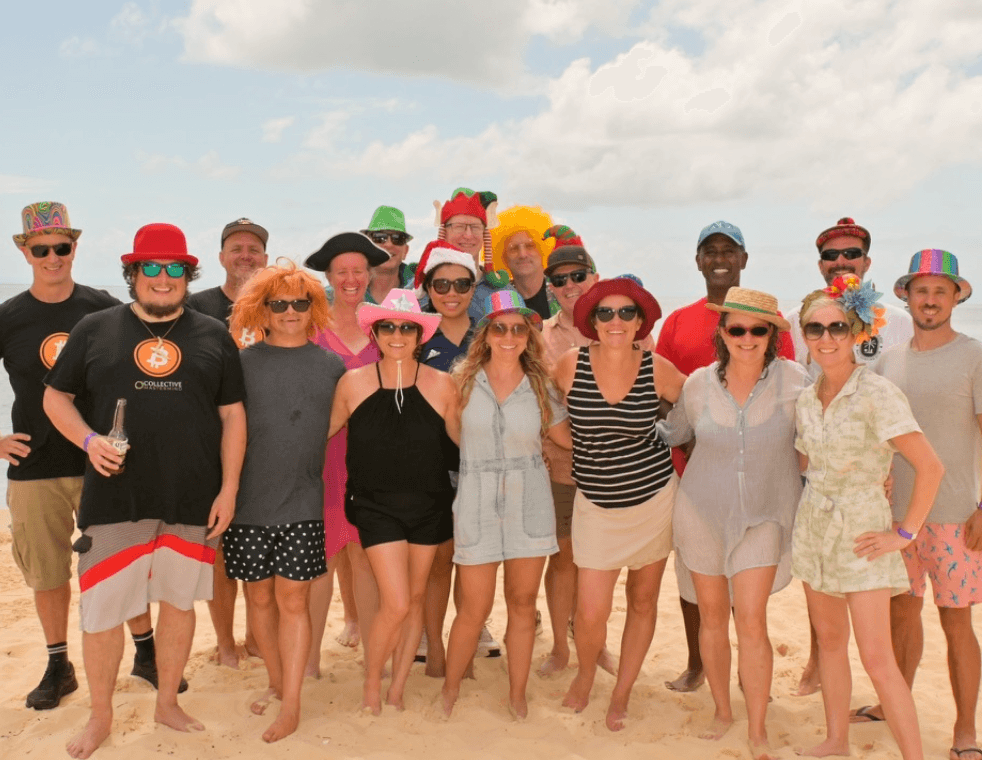
Every month in The Collective, Greg shares exactly what he and his team built and deployed in their own businesses in the last 30 days — which AI tools replaced which staff, which vibe-coded systems they shipped, which agents are running overnight, what changed in the stack. Not theory. Not a case study. What happened last week.
And so does every other serious operator in the room.
Members have used The Collective's AI sessions to:
- •Reduce reliance on expensive development teams by vibe coding internal tools in a fraction of the time
- •Deploy AI voice agents that handle inbound calls and outbound follow-up without a human team
- •Build lead magnets and client-facing tools in hours using AI that researches, writes and publishes
- •Train AI on their brand voice so it writes content, emails and proposals indistinguishable from their own
- •Build and launch micro-SaaS tools — new income streams — that didn't exist in their business six months ago
The standard is high because the room is high. Every decision gets pressure-tested against people who've already made it.
We're not a course. We're not a software subscription. We're a curated room of operators who are ahead of the market — and who stay ahead by staying in the room together.
By application only.
If you're doing $300K to $20M, already profitable, and you can feel that AI is creating a gap between where you are and where the market is heading — you're already in the right room. The only question is whether you'll walk in before that gap gets any wider.
Frequently Asked Questions
The AI advantage is being built right now. The room is open.
The Collective Mastermind is Australia's highest-level business, investing and AI mastermind. By application only.
AI is one of eight pillars we work on together — alongside business, marketing, sales, investing, biohacking, mindset and EQ, and lifestyle by design. Our AI sessions are run by operators who are actively building AI into real businesses, sharing exactly what they shipped last month, what's working and what isn't.
If you're doing $300K to $20M, already profitable, and you can feel that AI is creating a gap between where you are and where the market is heading — you're in the right room. The only question is whether you'll walk in before that gap gets any wider.
Apply for The CollectiveBy application only · We respond personally to every applicant · No high-pressure call

Greg Cassar
Founder, The Collective Mastermind
22+ years in business. Started selling online in 2003. AI-first operator since 2023 — has deployed voice agents replacing 30-person phone teams, vibe-coded internal tools that replaced SaaS subscriptions, built automated content pipelines, and trained AI on his brand voice across multiple businesses. Founder of The Collective Mastermind since 2015, rebuilt for the AI age. Also: 350+ businesses scaled, $500M+ in online sales, $100M+ in traffic spend, 400+ split tests. Lives in sub-tropical Byron Bay. Surfs every morning. Has planted 25,000+ trees and supports a charity providing food, shelter and safety for women and children.